Film Lighting Equipment Maintenance & Safety | UK Guide
Learn how to maintain film lighting equipment, inspect fixtures, manage accessories and plan safer production workflows for UK film and television crews.
Film lighting equipment maintenance
Film lighting equipment maintenance UK, professional lighting equipment safety, film lighting inspection, cinema lighting maintenance, lighting equipment servicing UK, film production equipment management, lighting equipment inventory management, film lighting safety procedures, professional gaffer equipment maintenance, LED film light maintenance, HMI lighting inspection, tungsten lighting maintenance, lighting equipment rental business, film studio equipment management, production lighting safety UK, film equipment servicing London, lighting equipment supplier Surrey, professional film lighting storage, cinema lighting equipment inspection, lighting accessories maintenance.
Film lighting equipment maintenance, professional film lighting safety, lighting equipment inspection UK, cinema lighting maintenance guide, film equipment servicing UK, lighting fixture inspection, LED film light servicing, HMI ballast inspection, tungsten fixture maintenance, professional lighting equipment storage, film production equipment checklist, lighting inventory management, film lighting rental inventory, lighting equipment condition checks, cinema lighting accessories, production equipment safety procedures, lighting cable inspection, professional film lighting cases, equipment maintenance for rental companies, gaffer equipment inspection, film studio lighting safety, lighting equipment lifecycle management, film production asset tracking, lighting equipment repair planning, lighting accessories inventory, electrical equipment safety for film crews, lighting equipment maintenance London, film equipment maintenance Surrey, lighting equipment Walton-on-Thames, professional lighting supplier UK, Light as Air.
Informational and commercial investigation.
United Kingdom, London, Surrey and Walton-on-Thames.
Film production companies, rental houses, gaffers, lighting technicians, studio operators and equipment managers.
film-lighting-equipment-maintenance-safety-uk.jpg
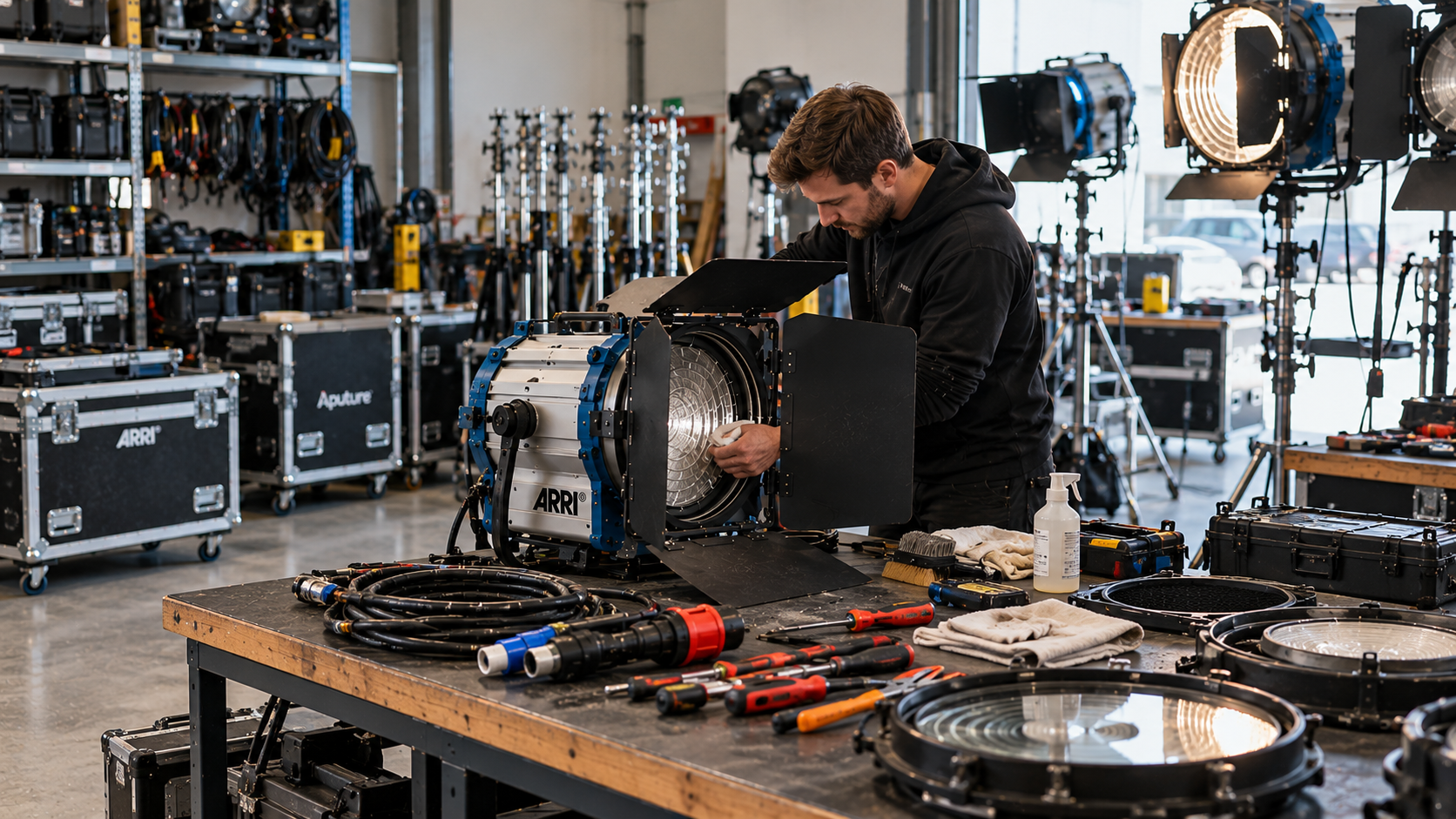
Professional film lighting fixtures, cables, stands and equipment cases arranged for inspection and maintenance.
Introduction: Why Equipment Maintenance Matters in Film Production
Professional lighting equipment is an important part of a film production's technical infrastructure. Fixtures, cables, stands, grip accessories and power equipment must work together reliably to support the production schedule.
A lighting problem can delay a setup, affect continuity or require the crew to change its equipment plan. In a rental business, poorly tracked equipment can also create confusion about availability, condition and maintenance history.
A structured maintenance process helps production teams identify issues before equipment reaches a location. It also makes it easier to organise storage, track accessories and plan servicing.
Maintenance is not limited to cleaning equipment after a shoot. It includes appropriate inspections, documentation, correct storage, safe handling and following the manufacturer's instructions.
For production companies researching professional equipment, Light as Air provides an online starting point for exploring lighting equipment sales and rental options.
1. Establish a Routine Equipment Inspection Process
Equipment should be checked at appropriate stages of its working life, including before use, after return from a production and whenever damage or unusual behaviour is reported.
The exact inspection process depends on the fixture type, its operating environment, the manufacturer's instructions and the risks associated with its use.
Visual Checks Before Use
A visual inspection can identify obvious issues before equipment is installed.
Check for damaged housings, cracked lenses, loose components, missing fasteners, damaged connectors and signs of impact. Look for cable damage, exposed conductors, bent mounting parts or other conditions that could make operation unsafe.
If equipment appears damaged, do not energise it merely to see whether it still works. Remove it from service and arrange assessment by a suitably qualified person.
Check Accessories and Components
Lighting packages may contain several components, including power supplies, ballasts where applicable, cables, mounting hardware, reflectors and control accessories.
Confirm that the equipment matches the inventory record and that essential components are present.
A missing cable or incompatible accessory may prevent a fixture from being used even if the main unit appears to be in good condition.
Document the Inspection
Use a consistent record to document the equipment identifier, inspection date, condition, reported issues and any action taken.
For a rental business, this information can help identify recurring problems and establish which items require servicing before the next booking.
Documentation should reflect actual checks performed. A completed checklist should never be treated as proof that an item is safe if the relevant inspection has not taken place.
2. Maintaining LED Lighting Equipment
LED fixtures are used in many film and television environments, but they still require appropriate care.
Dust, physical damage, obstructed ventilation, damaged connectors and faulty accessories can affect reliability.
Keep Fixtures Clean
Follow the manufacturer's cleaning instructions and use suitable materials for the fixture's housing, lens and optical components.
Avoid applying liquids or cleaning agents where they are not permitted. Equipment should be isolated from power before cleaning whenever required by the manufacturer's procedure.
Optical surfaces should be handled carefully to avoid scratches and damage.
Check Cooling and Ventilation
Many LED fixtures use fans, heat sinks or other cooling arrangements.
Inspect ventilation openings for dust or obstruction. Unusual fan noise, repeated thermal warnings or unexpected shutdowns may indicate a problem that needs professional assessment.
Do not operate a fixture with cooling systems that the manufacturer requires but which are damaged or not functioning correctly.
Review Control and Power Accessories
Check the condition of compatible power supplies, connectors, mounting points and control accessories.
For fixtures used with wireless or wired control systems, verify that the required accessories are present and that the equipment behaves as expected under the manufacturer's test procedure.
Any fault that could affect electrical safety should be assessed by a qualified person rather than handled as a routine cleaning task.
3. Looking After HMI and Tungsten Fixtures
Different lighting technologies have different maintenance requirements. A single checklist may not be sufficient for every type of fixture.
HMI Equipment
HMI systems can include a fixture, ballast, cables and other components. The full system should be checked according to the manufacturer's instructions.
Inspect the housing, connectors, cables, mounting arrangements and any visible damage. Lamp replacement, ballast servicing and electrical testing should follow the applicable procedures and be undertaken by appropriately qualified personnel.
HMI systems can involve high voltages and substantial power requirements. Never open or repair electrical components without the appropriate qualifications, isolation procedures and manufacturer guidance.
Tungsten Fixtures
Tungsten fixtures require attention to lamp condition, heat management, ventilation and electrical connections.
Allow equipment to cool according to the manufacturer's instructions before handling components that may be hot. Use only compatible replacement lamps and accessories.
Check housings, reflectors, lenses, mounting hardware and cable connections for damage.
Record Equipment-Specific Requirements
The maintenance record should identify the fixture model and any relevant manufacturer requirements. This makes it easier for the equipment manager to follow the correct inspection and service procedures.
For organisations managing different lighting technologies, clear equipment identification can reduce the risk of applying the wrong procedure to a particular fixture.
4. Cable, Power and Electrical Safety
Electrical safety is one of the most important considerations when preparing lighting equipment for a production.
Cables, connectors, distribution equipment and power accessories should be appropriate for the intended load and operating environment.
Inspect Cables and Connectors
Look for cuts, damaged insulation, exposed conductors, loose connectors, signs of overheating and other visible defects.
Damaged electrical equipment should be removed from service and assessed by a competent person. Tape or an improvised repair should not be used as a substitute for an appropriate repair.
Confirm Power Requirements
Before connecting a lighting package, check the manufacturer's electrical specifications and the available supply.
Consider the combined load, suitable distribution equipment, connectors, cable ratings and any specific requirements associated with the fixtures.
Where generators or complex distribution arrangements are involved, the system should be planned and operated by appropriately qualified personnel.
Manage Cables on Location
Cables should be routed to minimise trip hazards and protected from foreseeable damage caused by vehicles, equipment movement, water or public access.
Use appropriate cable protection where needed and keep routes organised so that the crew can move safely around the set.
The production team should assess conditions at the actual location rather than assuming a cable route that works in a studio will be suitable outdoors.
5. Safe Storage and Transportation of Lighting Equipment
Correct storage helps protect fixtures and accessories between productions.
Equipment should be packed according to its design and the manufacturer's recommendations. Fragile components, lenses and control accessories may require suitable protective cases.
Use Suitable Equipment Cases
Cases should provide appropriate protection against the handling and transport conditions expected.
Keep heavy equipment secured and distribute loads safely. Check case latches, handles, wheels and internal supports for damage.
Avoid packing equipment in a way that places pressure on lenses, connectors or sensitive components.
Organise Accessories
Use clearly labelled compartments, cases or storage areas for compatible accessories.
Cables, mounting hardware, reflectors and control accessories should be stored so that they can be identified quickly and returned to the correct package.
A consistent packing system can reduce the time spent searching for missing items during a busy production schedule.
Consider Environmental Conditions
Follow the manufacturer's instructions for storage temperature, humidity and environmental protection.
Equipment that has been exposed to rain, condensation, dust or other challenging conditions may need appropriate inspection and drying before storage or reuse.
Do not place damp equipment into closed cases when the manufacturer's instructions require it to be dried first.
6. Building an Effective Lighting Equipment Inventory
Inventory management is particularly important for rental businesses and production companies with large equipment collections.
A well-maintained inventory helps staff identify what is available, where it is stored, what accessories belong with each fixture and whether an item requires maintenance.
Give Each Item a Unique Identifier
Where practical, assign an identifier to each major fixture and important accessory.
Record the model, serial number where available, condition, storage location and relevant documentation.
The identifier should be easy for staff to match with the physical item and the inventory record.
Track Bookings and Returns
For rental businesses, record which equipment is assigned to each booking and when it is expected to return.
At return, compare the received equipment with the outgoing inventory. Document missing accessories, damage reports and any items that require inspection before being made available again.
This process helps prevent equipment with unresolved issues from being booked unintentionally.
Use Digital Records Where Appropriate
A spreadsheet or inventory management system can help track equipment details, maintenance dates, bookings and replacement costs.
The system should reflect the business's actual workflow. A smaller production company may need a simple record, while a large rental operation may require more advanced asset tracking.
Explore the lighting equipment categories when reviewing the types of equipment that may need to be tracked in a production inventory.
7. Preventive Maintenance and Service Planning
Preventive maintenance involves carrying out appropriate checks and servicing before an equipment problem disrupts production.
The correct frequency depends on the equipment, its usage, the manufacturer's guidance, the operating environment and any applicable inspection requirements.
Create a Maintenance Schedule
Record manufacturer-recommended servicing, required inspections, repairs and any relevant testing dates.
Set reminders where useful, but do not rely on calendar reminders alone. Equipment should also be assessed when damage, unusual operation or a specific incident indicates that an additional inspection is needed.
Track Repeated Faults
If a fixture repeatedly develops the same problem, record the symptoms and the actions taken.
This information can help a qualified technician investigate the underlying cause rather than treating each incident as unrelated.
Plan Repairs and Replacement
Equipment should not remain in circulation merely because replacing it would be inconvenient.
Where a fault affects safety or reliability, remove the item from service until the necessary assessment and repair have been completed.
For equipment approaching the end of its useful working life, compare repair costs, reliability, availability of replacement parts and the needs of the production business.
8. Hire or Buy Equipment with Maintenance in Mind
Maintenance is one factor to consider when deciding whether to hire or purchase lighting equipment.
Hiring can be practical when a production needs specialist fixtures for a short period. Purchasing may suit companies that use certain fixtures regularly and can manage the associated storage, servicing and inspection responsibilities.
Before hiring, confirm the equipment supplied, included accessories, collection or delivery arrangements and the process for reporting problems.
Before buying, inspect the product's condition, verify compatibility and review any available service history. Used equipment deserves particular attention to visible damage, missing components and electrical condition.
Compare the lighting equipment available for rental with the new and used equipment listed for sale to assess which approach suits your production needs.
Confirm current product availability, condition, prices and terms directly with the supplier.
9. Preparing Lighting Equipment for a Production
A pre-production equipment check should cover both the technical requirements and the practical organisation of the shoot.
Confirm the equipment list, fixture models, quantities, accessories, power arrangements and expected location conditions.
Where the production requires specialist equipment, establish whether the crew has the relevant experience and whether additional accessories or qualified personnel are needed.
Prepare a packing list and confirm the collection or delivery schedule. Keep the equipment inventory accessible to the staff responsible for checking items out and returning them.
For location work, account for access routes, weather limitations, transport arrangements and the space needed to install the equipment safely.
A structured preparation process helps reduce preventable delays and makes equipment handovers clearer.
10. Finding Professional Lighting Equipment for Your Production
The equipment required for a production depends on its creative brief, technical needs and available budget.
A specialist supplier's catalogue can help a production team research fixture categories, supporting accessories and potential rental or purchase options.
Light as Air provides an online catalogue of lighting equipment for sale and rental. Production teams can begin their research through the official Light as Air website and check the available options directly.
Before confirming an order, verify the product configuration, availability, equipment condition, hire period or purchase terms and any relevant collection or delivery arrangements.
Frequently Asked Questions
How often should film lighting equipment be inspected?
Inspection frequency depends on the fixture, its usage, manufacturer guidance and the applicable safety requirements. Equipment should also be checked when damage, unusual behaviour or an incident indicates that additional assessment is needed.
How should LED film lights be maintained?
Follow the manufacturer's cleaning and maintenance instructions. Keep ventilation clear, inspect connectors and accessories, and arrange professional assessment if the fixture shows signs of electrical, cooling or operational problems.
What should be checked on HMI lighting equipment?
Check the condition of the fixture, ballast, cables, connectors and mounting arrangements according to the manufacturer's instructions. Electrical inspection and servicing should be handled by appropriately qualified personnel.
How should lighting equipment be stored after filming?
Pack fixtures and accessories in suitable protective cases, organise cables and components, and follow the manufacturer's environmental storage requirements. Equipment exposed to challenging conditions may require inspection before reuse.
Why is lighting inventory management important?
Inventory management helps teams track equipment availability, accessories, bookings, maintenance requirements and missing items. It can also reduce confusion during equipment collection and return.
Should damaged lighting equipment be used if it still switches on?
No. A fixture that appears to switch on may still have an electrical or mechanical fault. Remove damaged equipment from service and arrange an appropriate assessment before reuse.
Is preventive maintenance important for lighting rental businesses?
Yes. Appropriate inspections, documented servicing and clear return procedures help rental businesses manage equipment condition and identify items requiring attention before another booking.
Conclusion
Professional lighting equipment requires appropriate care, documentation and safe handling throughout its working life.
By inspecting fixtures, maintaining cables and accessories, organising storage, tracking inventory and following manufacturer instructions, production teams can manage equipment more effectively.
For rental businesses, a structured maintenance system can also improve the visibility of equipment availability and outstanding service requirements.
Whether you manage a film lighting inventory or prepare equipment for individual shoots, maintenance should be part of the production workflow rather than an afterthought.
Visit Light as Air to research professional lighting equipment sales and rental options for film and television productions across the UK.
This article addresses common questions about lighting maintenance, inspections, inventory management and equipment safety.
To improve clarity for answer engines:
- Use descriptive headings for each maintenance topic.
- Answer FAQs directly and accurately.
- Avoid unsupported claims about equipment condition or service availability.
- Reference manufacturer instructions where appropriate.
- Keep the article relevant to the actual needs of production teams.
To support generative search visibility:
- Identify the intended audience as UK film and television production professionals.
- Use accurate company and location information.
- Link to relevant sales, rental and equipment category pages.
- Publish original, useful guidance on maintenance and inventory management.
- Maintain consistent business details across relevant websites and directories.
- Seek legitimate editorial mentions from relevant production and cinematography publications.
Article and BreadcrumbList. Use verified Organization or LocalBusiness details where appropriate.
Film lighting fixtures, cables and protective equipment cases arranged for inspection and maintenance.